
Stop Playing It Safe: How Your Comfort Zone Is Sabotaging Your Presentations

Updated: Mar 17
You know that voice in your head that whispers, "Just stick with what worked last time"? That voice sounds reasonable. Responsible. Professional.
It's also the fastest path to becoming forgettable because it lies.
Every time you step up to speak, whether it's a board presentation, a sales pitch, or a team update, you face a choice: protect your comfort or expand your range.
Most choose comfort. They reuse the same structure. The same energy. The same opening slides. They call it "consistency."
But consistency without stretch becomes stagnation.
And stagnation shows up as predictable mediocrity.
The Comfort Illusion
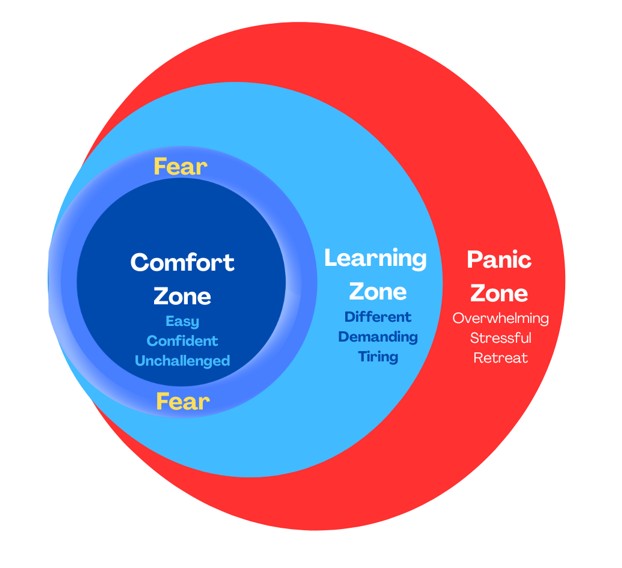
Comfort isn't inherently bad. In fact, it's often a byproduct of competence. When you've done something well many times, it feels easier.
But here's the problem: What feels easy to you often feels stale to your audience.
When a presentation feels automatic, something dangerous happens. You stop rehearsing with urgency. You stop cutting ruthlessly. You stop asking, "Is this actually landing?"
Psychologists have long documented the relationship between arousal and performance (often illustrated by the Yerkes-Dodson curve): too much anxiety hurts performance, but too little does too. A moderate level of tension sharpens focus, preparation, and clarity.
Fear isn't your enemy. It's your signal that the moment matters.
Remove that tension entirely, and you often remove the edge that makes you sharp.
Comfortable speakers don't fail dramatically. They plateau quietly.
And plateaued performance is far more common and far more dangerous than collapse.
The Complacency Tax
When you stay inside your comfort zone, you pay a price:
You recycle material that once worked but no longer resonates.
You default to delivery patterns that feel "professional" but lack energy.
You avoid testing bold openings, sharper stories, or cleaner structure.
You wing it more than you admit because "you've done this before."
Familiarity breeds overconfidence. Overconfidence reduces rehearsal. Reduced rehearsal lowers impact.
It's subtle. It's gradual. And it's expensive.
Because audiences don't reward familiarity. They reward clarity. Relevance. Presence.
And those require intention.
The Skills You're Not Building
Your comfort zone is designed to minimize risk.
Which means every time you stay inside it, you're opting out of growth.
You don't learn to read resistance if you refuse to stay present. You don't build agility if you avoid asking that next question that dives deeper. You don't develop authority under pressure if you never test new framing in high-stakes environments.
The speakers who improve fastest aren't the naturally gifted ones.
They're the ones who experiment.
They try an opening that feels too direct. They pause longer than feels natural. They cut their "context slides" and trust the audience to catch up. They make eye contact with the skeptic instead of avoiding them.
At first, it feels wrong. Exposed. Risky.
That friction is not a flaw in the process.
It is the process.
The Myth of Effortless Flow
Many leaders chase the idea of becoming a "natural speaker", someone who flows effortlessly, without nerves, without strain.
That's a myth.
Even highly skilled communicators feel activation before high-stakes moments. The difference is not the absence of tension, it's the management of it.
They've stepped into discomfort so many times that they've built range. They've developed recovery skills. They trust themselves to adapt mid-sentence, mid-slide, mid-question.
They don't eliminate discomfort.
They metabolize it.
The goal isn't to feel calm all the time.
The goal is to perform effectively even when you're not.
What Growth Actually Looks Like
Real improvement rarely feels smooth.
It looks like:
Testing a story that feels slightly too personal.
Reworking your structure instead of defaulting to last quarter's deck.
Practicing out loud when you think you don't need to.
Inviting honest feedback from someone who won't protect your ego.
Letting silence sit in the room instead of rushing to fill it.
Each of these creates tension.
And tension, when handled intentionally, builds capability.
When you step outside your comfort zone, you don't just become more confident. You become more versatile. You stop needing perfect slides. Perfect conditions. Perfect audiences.
You become effective anywhere.
The Real Question
So ask yourself: Are you optimizing for looking polished? Or for being understood, trusted, and remembered?
Because if "polished" means safe, predictable, and controlled… you may be protecting your ego more than you're serving your audience.
Growth in communication isn't about eliminating fear. It's about choosing progress over protection.
And every time you stand up to speak, that choice is yours.
Become a Master Communicator.
If you were reading The Alignment Brief newsletter, go back to the newsletter to access the next article.


Comments